Project For Building News
Horizontal and vertical acoustics: designing acoustic comfort in buildings
The perceived quality of a building is closely linked to the control of impact noise, vibrations and sound transmission between adjoining spaces.
For designers, engineers and construction managers, effective acoustic performance cannot be achieved through superficial interventions at the end of the construction process. It requires structural planning integrated directly into the building build-ups.
At Project For Building, we address this need with the DAMPER System: a range of structural solutions made from recycled rubber, designed for slabs, floors and partition walls.
Horizontal vs vertical acoustics: two different physical behaviours
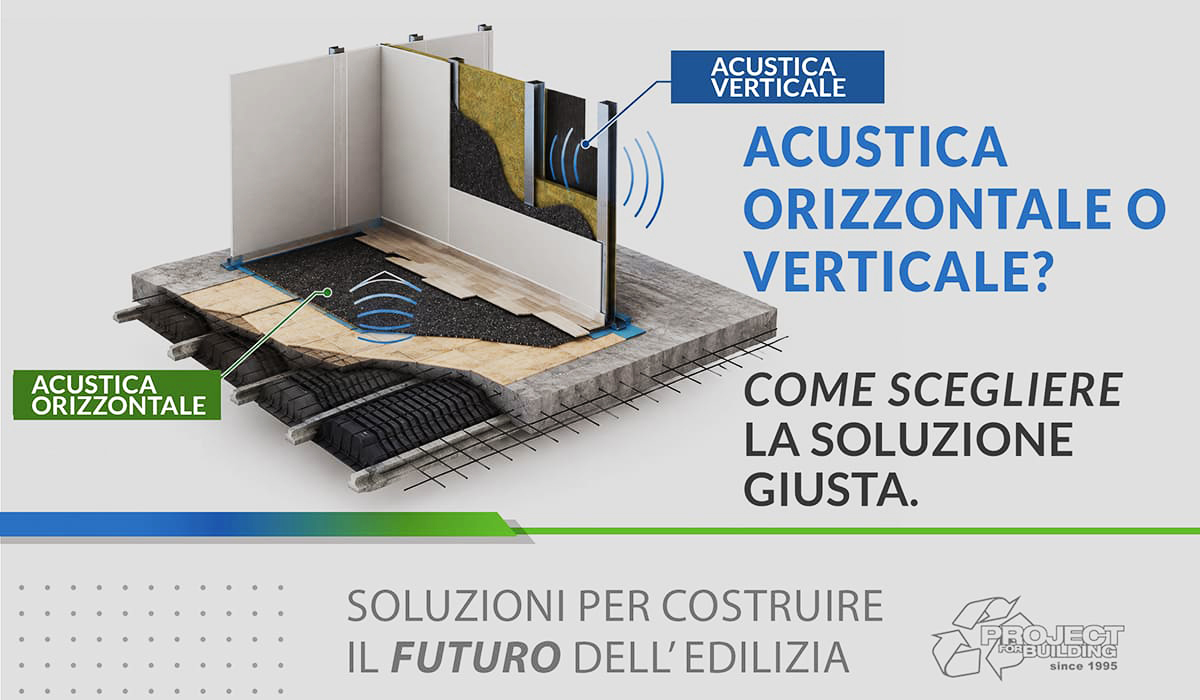
A common mistake when searching for the most suitable system is looking for a “universal” soundproofing panel. Effective acoustic insulation, however, requires a clear distinction between two different types of wave transmission.
Horizontal acoustics: controlling impact noise through floor slabs
Footsteps, impacts and dragging generate mechanical waves that propagate through the floor slab structure to the spaces below.
The problem: increasing the mass or thickness of the floor alone is not enough.
The structural solution: a resilient element is required beneath the screed or flooring. Our Damproll, Damptile and Damparquet systems interrupt vibration transmission at its source.
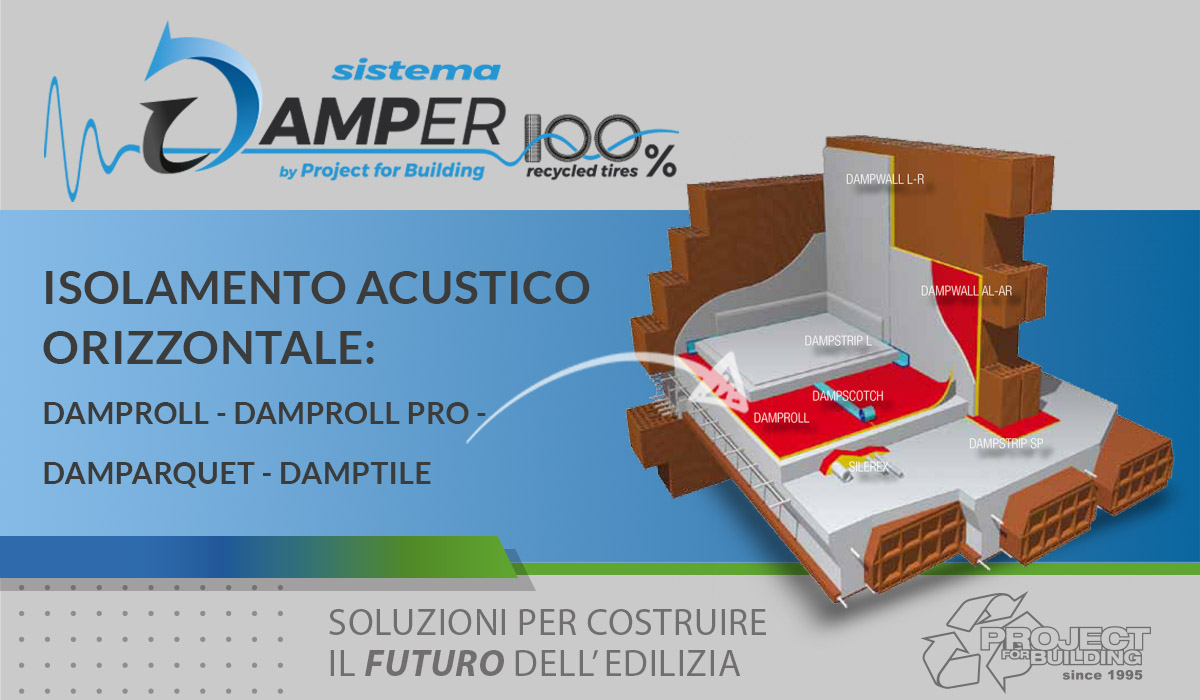
DAMPER System Products for Horizontal Acoustic Insulation – Project For Building
Vertical acoustics: insulation against airborne noise
This concerns the propagation of sound through partition walls, caused by conversations, televisions and building services.
The problem: in lightweight walls or modern dry construction systems, mass alone does not provide sufficient sound reduction.
The structural solution: Dampwall AR and Dampwall LR systems create a resilient cavity capable of dissipating sound energy and reducing vibration transmission between adjoining residential units.
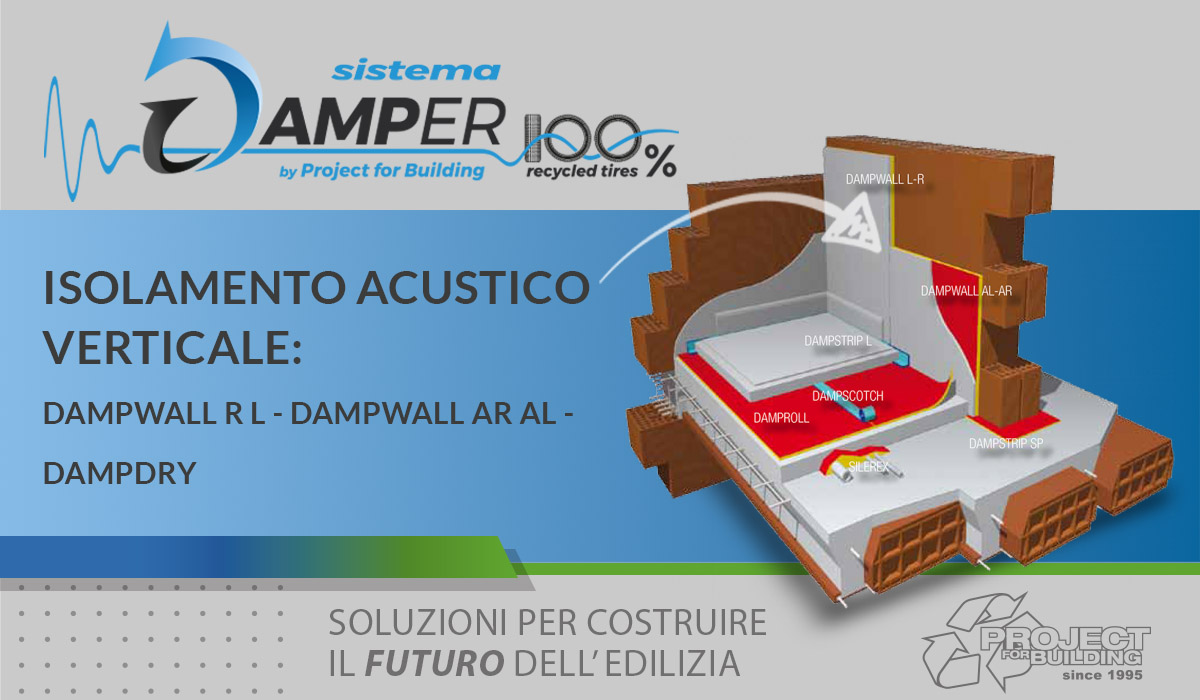
DAMPER System Products for Vertical Acoustic Insulation – Project For Building
The value of recycling: where sustainability becomes performance
Our research into applied acoustics stems from extensive expertise in the recovery and processing of recycled plastic and rubber.
The compounds used in the DAMP System are produced directly from recovered tyres and selected polymers, processed to create materials with high density and high elasticity.
At Project For Building, sustainability is not an additional feature or simply a label: it is the driving force behind technical performance, as documented in our company’s Sustainability Report.
From a physical perspective, the structure of recycled rubber provides unique properties that make it possible to:
- Dampen vibrations: by interrupting the structural continuity of rigid materials.
- Dissipate sound energy: by converting acoustic waves into microscopic thermal energy.
- Ensure long-term stability: the material does not compress and retains its elastic properties under load for decades.
This virtuous circular economy approach ensures full compliance with the 2026 Minimum Environmental Criteria for Construction (CAM) and responds directly to the growing demand for recycled and certified materials in contemporary projects.
Beyond the “panel”: why acoustic insulation is structural
Sound absorption is often confused with acoustic insulation. Conventional exposed acoustic panels only reduce reverberation and echo within a room.
The DAMPER System, on the other hand, works invisibly within the building structure. How? By mechanically decoupling structural elements to physically prevent noise from being transmitted from one space to another.
Making room for silence: Project For Building’s design approach
Our engineers develop acoustic systems based on the real needs of designers, construction companies and building sites.
The goal is to improve living comfort through high-performance materials, continuous research and integrated solutions that work invisibly within the building structure.
Because in construction, silence is always the result of a precise design choice. 🌿
FAQ – Technical answers for designers
Are soundproofing panels applied to walls sufficient to insulate an apartment in accordance with Italian law?
No, they are not sufficient to ensure compliance with legal requirements. In Italy, the D.P.C.M. of 5 December 1997 defines the passive acoustic requirements for buildings and requires a minimum design apparent sound reduction index of 50 dB for partition walls between separate residential units. Surface-mounted acoustic panels reduce internal echo but do not block structure-borne noise. To achieve the legally required 50 dB, resilient systems such as Dampwall must be incorporated into the wall build-up.
How can impact noise be effectively reduced, and what are the regulatory limits?
Impact noise can be effectively reduced by introducing resilient materials beneath the screed or flooring. Under the D.P.C.M. of 5 December 1997, the normalised impact sound pressure level for residential buildings must not exceed 63 dB. Systems such as Damproll create a “floating floor” that interrupts acoustic bridges and prevents impact waves from propagating into the floor slab below, ensuring full compliance with the statutory limit.
Why is recycled rubber considered an excellent acoustic material?
Thanks to its combination of high density and elastic behaviour. These physical properties allow recycled rubber to absorb and dampen vibrations far more effectively than other rigid or fibrous materials, while maintaining its performance and thickness over time.
Does the DAMP System comply with the CAM requirements for construction contracts?
As our solutions use recovered polymers and tyres, they fully comply with the recycled material content requirements established by the new Minimum Environmental Criteria for Construction Decree (D.M. 2 February 2026). This allows designers to specify DAMP systems in both public procurement specifications and private projects focused on sustainability.